Allegro Ads that grow your profit, not just your sales.
We run campaigns that take into account your margin, seasonality and the full picture of your business. We do not focus solely on pushing ROAS up, but on scaling your sales intelligently.
Total revenue our clients generate from Allegro Ads
“
Our business goals are much easier to achieve with Traffic Trends. It is a partner that not only understands the Allegro advertising system very well, but also the specifics of our business, its seasonality and the risks of competition and price wars. I definitely recommend them!
Grzegorz Wiśniewski
Clineo.pl, Bolsius.pl
How do we want to work with you?
You are surely not looking for information on what Allegro Ads is, but for someone who will support you in it at the highest level. That is why we want to show you how we work and how we care about your profit.
To that end:
Product data
We work based on product data: popularity, margins and price attractiveness
Conversion tracking
We meticulously set up conversion tracking
Ad formats
We choose the most effective ad formats for your goals
Seasonality
We use seasonality, adjusting budgets and campaign scope to real demand rather than historical statistics
Transparency
We communicate transparently what is realistic, what the process looks like and when it is worth taking action
E-commerce
We simply understand e-commerce: since 2011 we have supported thousands of projects to grow their sales
We want to start with a free, no-obligation analysis of your Allegro account.
It will result in a unique advertising strategy for your company, built around your business goals: maximising sales value, improving profitability and growing leads.
As part of the strategy you will see, among other things, the ad formats we recommend and their role in the sales funnel.
Cooperation schedule
If you like our idea and quote, we will sign a safe, client-friendly contract and get to work. At the start:
BRIEF
We will ask for information about your business goals, sales volume and the expected level of profitability.
FORMATS
We will talk about your most important offers and categories to match them with the most effective ad formats. The ad budget will be directed to the areas that matter to you.
ANALYSIS AND STRUCTURE
We will analyse your Allegro seller account and build an ad campaign structure tailored to it.
ADDITIONAL FORMATS
If there is room for it, we will propose testing additional ad formats (e.g. graphic ones) and prepare the necessary materials for you.
REPORTS
We will take care of reports and regular recommendations for your account and offers.
And once the machine is running...
...our Allegro Ads Specialist will regularly work on optimising your campaigns:
Campaign structure
Build the right campaign structure tailored to your account.
Product updates
Keep your products in the ads up to date.
Performance analysis
Continuously analyse the performance of all offers and take action to direct the budget to the most effective ones.
CPC bid adjustment
Use our unique tools to adjust the CPC bids of your ads for the most effective selling hours.
Testing and scaling
Once a satisfactory ROAS level is reached, test new solutions to scale and keep growing your sales.
Segmentation
Focus ad delivery on the best-performing placements by introducing the right segmentation and bids.
AdTech
We base our effectiveness not only on a team of experienced Allegro Ads specialists, but also on advanced advertising technology that supports the results! Our campaigns are supported by extensive proprietary software as well as AI-based solutions. By working with us you get not only account management, but also an advanced, modern advertising ecosystem!
How does our software help?
Excluding ineffective offers
Ad scheduling
Budget regulation
Ad graphics
CPC regulation
Anomaly alerts
Video ads
Moving offers between groups
Offer list display
20+ more
Graphic support for Allegro Ads included in the price!
Yes, you read that right - as part of running your Allegro Ads we provide graphic support at no extra charge! The graphics and animations you need, created with the help of artificial intelligence, will be produced for you throughout the whole Allegro Ads contract!
We have been running Allegro Ads campaigns since the beginning of 2019. We are the highest-ranking Allegro Ads Partner+, and we were the first company in history to earn the Education Champion distinction.
For clients using Allegro Ads we guarantee a unique combination of specialists and advanced technological support! It is the cooperation of an experienced team with modern advertising technology that allowed Traffic Trends to become a leading performance marketing agency for e-commerce.
50+
e-commerce specialists on the team
15+
years of e-commerce experience
450+
open projects for online stores
4 mln+
monthly ad spend managed for online stores
Certifications
Our badges
Our strength is the ability to work effectively across many advertising systems and to build a funnel that goes beyond a single channel.
Our experience and quality of work are confirmed by partner statuses from the largest platforms:
Partner Premium Google
Business Partner Meta
Allegro Ads Partner+
Advertising Partner Microsoft
Google CSS Partner
Google Partner Awards EMEA
Education Champion Allegro Ads
Google Partner Premium
Meta Business Partner
Allegro Ads Partner+
Google CSS Partner
Microsoft Advertising Partner
Google Partner Awards EMEA
Education Champion Allegro Ads
Certified Google, Meta, Allegro and Microsoft partners – one team, a full advertising ecosystem.
Allegro Ads allows very precise measurement of results. Whatever your goal is (sales, a submitted lead, visits to a specific page), we measure effectiveness for every campaign and every ad group, report on it and optimise campaigns on that basis.
Yes! When we start working together you get access in the Client Panel to reports that are updated daily. The reports contain the most important information, including the revenue generated and the return on ad spend. You can see the details in the demo version of the Client Panel.
In theory the advertising system is the same. But behind our service is a unique combination of experienced specialists and extensive advertising technology. Campaign optimisation is not based only on manual work: it uses many algorithms for data analysis and machine learning, designed to give your company the best sales results.
Partner+ is the highest partner status in Allegro Ads. It means we are a verified partner with the highest service quality, meeting all of Allegro's requirements regarding the number of clients, ad spend and the quality of services provided.
Campaign optimisation is a continuous process made up of many smaller tasks performed cyclically by Allegro Ads specialists, with the aim of achieving the best possible campaign results. As part of it we modify ad content, adjust CPC bids, exclude ineffective offers and so on. Dozens of technology solutions support us throughout the process and keep the work running smoothly at a higher pace.
The contract is very safe and flexible. We care a lot about your comfort, so we offer an open-ended contract with a very short notice period of just one month.
To run the advertising we need a configured analytics environment and an Allegro Ads account. Depending on the chosen ad formats, you may also need graphics or video ads. If anything is missing at the setup or creative stage, we will gladly take care of it as part of our cooperation.
In theory there is no minimum. If you want to spend, say, a few hundred zlotys on a campaign, the additional cost of management may make the campaign ineffective and unprofitable. Many of our clients start their Allegro Ads journey with a budget of PLN 2,000-3,000 per month.
Of course. The ad budget is fully flexible. We understand very well how sales depend on the season, the weather or even the day of the month and the time of day, so we will fully adapt the budget to your campaign financing plans.
Allegro Ads - a guide to advertising on Allegro
Everything worth knowing about Allegro Ads - from the auction system and CPC rates, through ad formats, to optimisation, ROAS and the FAQ.
Allegro has more than 21 million active buyers and the platform's GMV has exceeded PLN 69 billion. Advertising revenue grows 38% year on year, and more than 140 thousand sellers compete for the attention of the same customers. In such conditions advertising stops being an option - it becomes a necessity for anyone who wants to sell effectively on Allegro.
Key takeaways:
Allegro Ads is an auction system working in maximum CPC, CPM and dynamic CPC models - similar in mechanism to Google Ads (AdWords), but adapted to Polish e-commerce.
The available formats are Sponsored Offers ads, Display (graphic) and Video ads, and Ads4Brands - each serves a different purpose in the sales funnel.
You can launch a campaign from just a few zlotys a day, and well-configured parameters can deliver good results and a high ROAS.
The minimum daily budget depends on the set of placements you choose for an ad group. For Sponsored Offers, the minimum daily budget on Allegro.pl is:
PLN 3 - if you choose placements available only on Allegro PLN 10 - if you choose only Google Search as a placement PLN 10 - if you choose placements available on Allegro and in Google Search. For Display ads the minimum daily budget is PLN 15.
To ensure steady ad delivery throughout the day, you should usually use budgets higher than the minimum. The optimal value depends strongly on both the popularity of the advertised offers and their number in a given ad group.
The most common reason for "non-working" Allegro Ads is not a system failure, but a CPC bid that is too low, a poorly chosen budget or low quality of the offers themselves.
What is Allegro Ads and why use it?
Allegro Ads is the advertising system built into the Allegro platform, working in two billing models: CPC (cost per click) and CPM (cost per thousand impressions). Technically the mechanism resembles Google Ads, with the difference that advertising takes place inside Poland's largest e-commerce portal rather than in a classic search engine.
This difference matters a great deal for business: Allegro users browse the site with a clear, direct purchase intent. As a result, these campaigns generate much higher conversion rates than ads in a traditional search engine, where users are often only just looking for information.
The scale of competition means organic search results are not enough. With over 140 thousand active sellers and GMV above PLN 69 billion, keeping an offer visible without paid support is getting harder and harder.
To plan your budget effectively and choose the right tools for your business goals, you first need to know the basic technical parameters of each available format. They differ not only in placement, but above all in billing model and minimum entry threshold.
Keep in mind, though, that although the minimum budgets required by the platform are very low, they rarely prove sufficient for effective advertising. To ensure steady and visible ad delivery during the day, you usually need to allocate more funds. The final, optimal amount will depend strictly on current market trends, the popularity of the promoted assortment and the number of offers you decide to advertise.
The table below shows the key differences between the two main campaign types in the Allegro Ads ecosystem:
Ad format
Billing model
Where it is shown
Campaign goal
Minimum daily budget
Sponsored Offers
CPC
Search results / product pages
Sales
PLN 3 - 10
Display ads (Graphic/Video)
CPM
Home page / categories / search results / product pages
Brand awareness and sales
from PLN 15
How does the Allegro Ads auction work?
Allegro Ads uses a real-time bidding (RTB) mechanism. Every time a user types a phrase into the search box, the system runs an auction in a fraction of a second between all advertisers competing for a given keyword or category. The final cost per click is determined by three factors: the maximum CPC bid set by the seller, the competitiveness of the category and the offer quality score. The latter takes into account, among other things, the relevance of the title, photo quality, sales history and buyer ratings. Ads are shown in search results, on category pages, in related-products sections and directly on product pages.
Understanding the auction mechanism is the first step to selling effectively - without that knowledge it is hard to manage your budget consciously. Sellers who feel that Allegro ads "do not work" most often do not have a system failure - their campaigns simply lose auctions because of a CPC bid that is too low or poor offer quality (quality score). The system will not show ads if the offer does not meet the minimum quality thresholds, even with a sufficient budget.
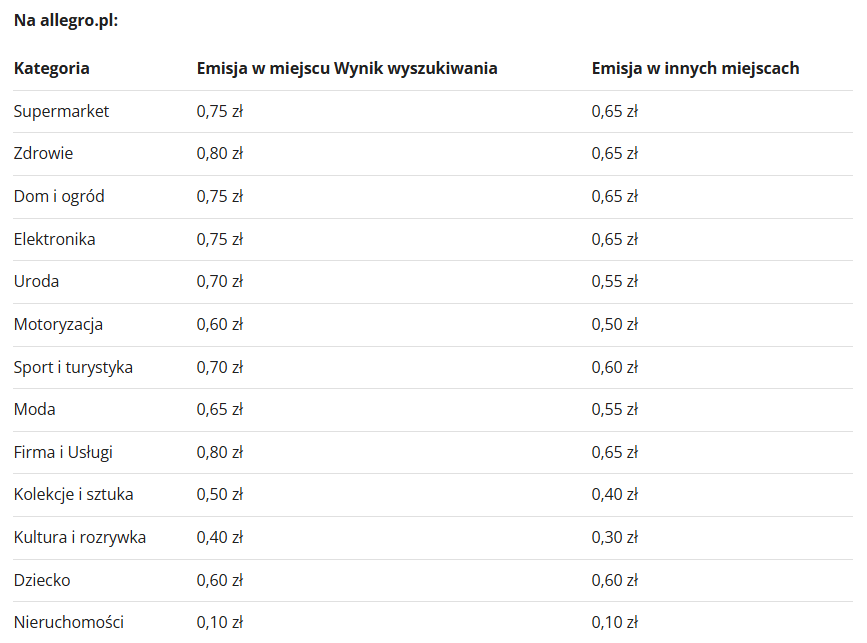
How much does advertising on Allegro cost - what are the CPC rates?
How do I set up an Allegro account and my first ad campaign?
Before you launch your first campaign, you need an active seller account. The process of setting up an Allegro account goes step by step like this: you register a seller account on Allegro.pl, go through identity and company data verification (or the data of a sole trader), and then activate the Allegro Ads panel in your account settings. After successful verification the advertising panel activates automatically. It is worth starting campaign configuration by defining your goals. Do you want to maximise sales, or significantly increase the visibility of your offers and build brand awareness on Allegro? Whatever your assumptions, the system offers ad formats suited to each of these needs.
How do I choose products for the first campaign?
The choice of products depends on the budget you want to allocate to the campaign and on its goal. If you are taking your first steps and want to see how the system works, choose your bestsellers. This also boosts their sales further, and popular offers can encourage buyers to visit your store and check the rest of your assortment. By choosing products that already sell well organically, you minimise the risk of burning the budget on ineffective offers and a low ROAS.
If, however, your goal is to increase total sales volume or to promote items that have so far drawn few clicks, you can safely add your entire assortment to the campaign.
Remember, though, to prepare the campaign structure properly and to define budgets and CPC bids precisely (details below), and above all to keep monitoring and make regular optimisations. Without well-thought-out actions, ads can generate considerable costs with no satisfying results.
It is also worth remembering that some users use ad-blocking plugins. On Allegro some of them can completely block display ads. That is why combining different formats (e.g. Sponsored Offers and display ads) increases reach and minimises losses caused by banner blocking.
How do I set the budget and CPC bidding strategy?
The starting point is generating regular impressions and clicks, which lets you collect statistically significant data for later optimisation. Manual bid setting gives you full control and works well for experienced sellers, allowing you to direct the budget precisely to the most effective offers.
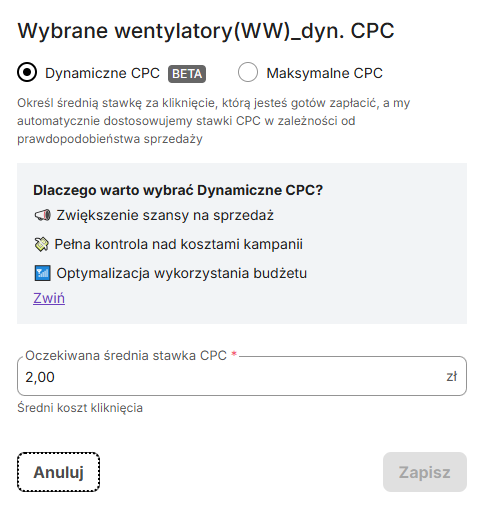
Dynamic CPC (automatic), in turn, lets the system raise the bid up to twice (up to 2x the set average CPC) when the algorithm assesses the chance of conversion as high. This mechanism is not suitable for all offers, however. For some products the algorithm can drastically limit impressions, so assortment for ad groups with dynamic CPC should be chosen carefully. A good choice to start with is products that already sell and whose costs you want to optimise a little.
source: Allegro Ads panel
Beware of a common mistake: the daily budget is set at the ad group level, not for the whole campaign. This means that if you put too many offers into one group and assign it too small a budget, the funds may run out early in the day. The key to success is a well-thought-out split of ad groups and a flexible allocation of the budget depending on current trends. In periods of high seasonality - such as Black Friday, Christmas or Back-to-School - CPC rates may rise because of the huge competition. Campaigns then generate far more impressions and clicks (and therefore costs), so ad budgets should be planned with a suitable reserve.
Remember that a campaign that "does not work" is most often the result of a CPC bid that is too low or a daily budget that is too low. Before you start looking for a system failure, check these two parameters. Based on the collected statistics you can also assess the quality of your offers. For example: if an ad generates plenty of impressions but few clicks (low CTR), check the thumbnail and the title - see whether they present the product well and answer buyers' needs precisely.
source: Allegro Ads panel
How do I use the individual Allegro Ads formats effectively?
The choice of ad format should result from the stage of the sales funnel and the specific goal of the campaign. Sponsored Offers work well for closing sales, while display and video advertising on Allegro builds brand awareness in the CPM model. Mixing formats within one strategy can give better results than relying on a single ad type.
How do Sponsored Offers campaigns work and when to use them?
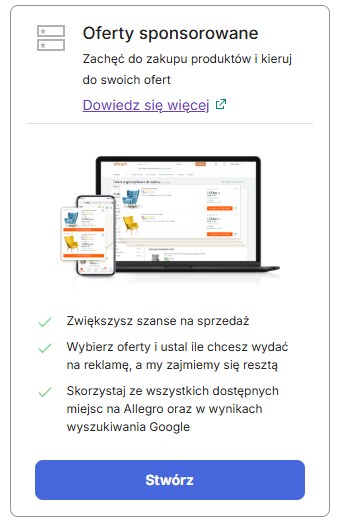
Sponsored Offers are the best entry point for sellers - both those taking their first steps in Allegro Ads and experienced ones who know how to use them to their advantage. Ads appear alongside offers with a purchased extra promotion and those from organic search results, so they reach users with a clear purchase intent. It is a mechanism analogous to Search campaigns in Google Ads. This format works both for products with documented demand and for new items that need to quickly gain visibility in search results. It is most effective, however, when combined with popular offers that already have high buyer ratings.
source: Allegro Ads panel
How does Allegro display advertising work and when to choose it?
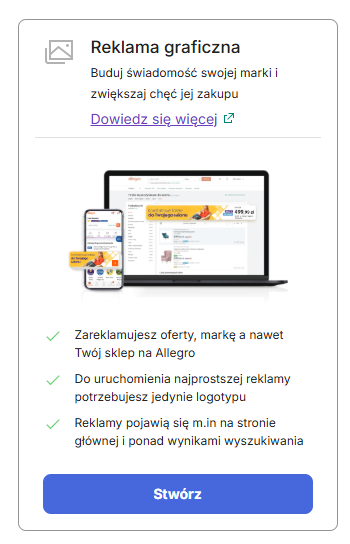
Display advertising on Allegro is a display format billed in the CPM model - you pay for a thousand impressions, and the cost ranges from a dozen or so to several dozen zlotys depending on category and season. A display ad adjusts to the phrases the buyer types into the search box, as well as to the categories they browse. Unlike Sponsored Offers, you can control the keywords the ad should appear for and add negative keywords. You also decide on the reach of the ad (precise or extended) depending on which group of users you want to reach.
source: Allegro Ads panel
source: Allegro Ads panel
Display advertising in the "brand store" format, as well as on the home page, involves high costs. It is intended mainly for sellers who have separate budgets for building reach and marketing campaigns and who are aware that these do not always translate directly into sales. It is also worth noting that these display ad formats are available only to selected Allegro Ads agencies or sellers with special permissions that extend the basic Ads functionality.
That is why in this article we focus on the three most popular formats: template, standard banner and flexible.
In template ads it is enough to provide a logo and select 4 products to promote. The platform will rotate them dynamically, showing at most 2 offers at a time. Make sure your logo is of good quality and that a short advertising slogan (up to 35 characters) catches the attention of Allegro shoppers and is consistent with the advertised offers.
An effective banner creative, in turn, should have a clear message, a readable call to action (CTA), a standout colour palette and be consistent with the brand image. Remember to choose precisely the keywords you want to show your ads for. Since you pay for every impression, make sure the phrases are as exact as possible and match buyers' queries perfectly.
For flexible banners the rules are very similar, but this format adapts to many different resolutions and device screens. This means you must prepare the graphic creatives so that they look attractive and undistorted on every display.
Display ads work best as a complement to sales campaigns. Their main role is building brand recognition, which over time translates directly into a higher conversion rate in Sponsored Offers. Presenting the most attractive products this way also generates their direct sales, so it is worth implementing and testing this format on your account.
Keep in mind, however, that ad blocking by users with an ad blocker lowers the real reach of CPM campaigns - one of the main reasons to combine this format with CPC models.
How does video advertising work in Allegro Ads?
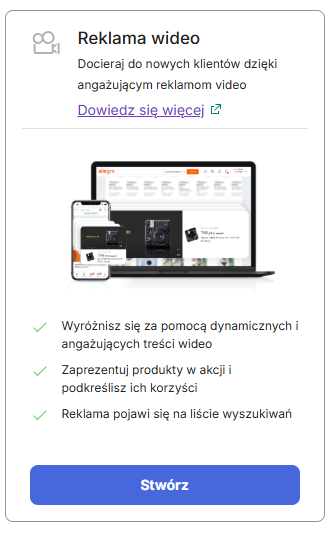
Video advertising is an ad solution that every seller on Allegro can use. Unlike standard ad graphics, it lets you present the product in use. It is ideal for highlighting its best features, functions, uses, details and the real benefits of using it.
Like display advertising, video advertising adapts to the phrases the buyer types into the search box, as well as to the categories they browse. Here too you can control the keywords the ad should appear for and add negative keywords. You also decide on the reach of the ad depending on which group of users you want to reach.
source: Allegro Ads panel
What is the Brand Zone / Ads4Brands and who is it for?
Although activities dedicated to brands are not a separate format in Allegro Ads, they are worth mentioning. They make it possible to advertise products even when you do not sell them directly on your own account.
If you are a manufacturer, a brand owner or an official distributor representing a brand on the Polish market, your main growth lever may be the Brand Zone programme - Ads4Brands. It is a dedicated ecosystem created for companies that want to promote their assortment globally and protect their own keywords from competitors, even if they do not run direct retail sales on the platform themselves.
With a brand account you get access to advanced tools that let you manage the promotion of your whole assortment from one panel. Besides classic Sponsored Offers you have reach formats at your disposal: engaging video ads and large-format flexible banners in the most prestigious places, including the Allegro home page. These activities are complemented by dedicated brand stores (Brand Pages) - your own mini-sites inside the portal that showcase the brand image and effectively cut customers off from competitors' offers.
Because of its complexity and the multitude of advanced features, the Brand Zone can be quite demanding. To make the best use of its potential and not burn budgets, it is most often entrusted to experienced marketing agencies. An alternative is working directly with Allegro itself - the platform offers brands support from dedicated account managers and various flexible partnership terms adjusted to the scale of the business and the brand's image goals.
How do I optimise Allegro Ads campaigns and measure their performance?
Optimisation is a continuous process, not a one-off campaign setup. The key to success is constant monitoring of results, proper reallocation of budget between ad groups and well-matched CPC bids, based on hard data such as ROAS (return on ad spend), CTR (click-through rate) or sales value. The ability to tell converting offers from those that eat the budget without effect is exactly what distinguishes effective sellers from those whose Allegro Ads campaigns "do not work" despite regular spending.
Which metrics should I monitor in the Allegro Ads panel?
For Sponsored Offers you have 9 metrics at your disposal:
clicks – the number of clicks on your sponsored offers
impressions – the number of times your sponsored offers were displayed
CTR – the ratio of clicks to the total number of offer impressions
CPC – the average gross price per click, i.e. the total cost of all clicks divided by the number of clicks
cost – the sum of the gross costs of all clicks generated by the sponsored offer
ROAS (return on investment) – the revenue generated after a click on a sponsored offer for every zloty spent in Allegro Ads
interest – the total number of offers watched and added to the cart within 7 days from the click on a sponsored offer
items sold – the total number of offers sold, counted for 7 days from the click on a sponsored offer
source: Sample statistics in the Allegro Ads panel
The most frequently analysed metrics are CTR, CPC, cost, ROAS and sales value. On their basis you can draw accurate conclusions and decide which elements of the campaign need improvement. An important part of analytics is also constantly watching the percentage of the budget used during the day in each ad group. This way you will learn whether the allocated funds are sufficient for all-day ad delivery or whether the budget runs out too early, limiting your reach.
For display and video ads, the additional parameters to analyse are:
average CPM – the average gross price you pay per 1000 impressions of your Display ad. This lets you compare that amount with the maximum CPC bid you set in a given ad group.
reach – the number of people who saw your Display ad at least once
assisted sales – the gross value of sales that was attributed to sponsored offers, but in generating which a Display ad also took part - meaning the customer reached your offer thanks to the Display ad and later through sponsored offers, but the system assigned such sales to only one campaign, here the sponsored offers
items sold – the total number of offers sold, counted for 7 days from the click on a Display ad and 1 day from its impression. Check whether this list includes products you do not advertise yet. If so, and you see many of them sold, add them to an ad group or create a new group. This way you will start advertising them, which will cause an additional increase in sales of that product.
sales value – the total gross value of offers sold, counted for 7 days from the click on a Display ad and 1 day from its impression.
Regardless of the chosen ad format, you can also add data and analyse the campaign broken down by additional metrics, for example ad placement. This will let you check:
where your ad appears most and least often
which placements bring you the biggest profit
where it is worth raising the CPC bid.
How do I run A/B tests of ads on Allegro?
A/B tests on Allegro differ significantly from those known from, say, Google Ads - on this platform you modify the parameters of the offer itself, not the ad creative. This can be the offer title (e.g. the order of keywords, adding numbers or attributes such as colour), the main photo (e.g. a different presentation of the product), the price or delivery terms. All these modifications directly affect offer quality - and the higher it is, the better the results it will achieve in Allegro Ads.
If you want to test different CPC bids, daily budgets or check how dynamic CPC works, remember an important rule: do not create A/B tests (separate ad groups) with exactly the same offers. In such a scenario the algorithm will always favour the group with the higher bid, limiting impressions of the cheaper one, so the results will be distorted.
A better solution is to introduce a change in, for example, CPC and constantly observe what effect it brings.
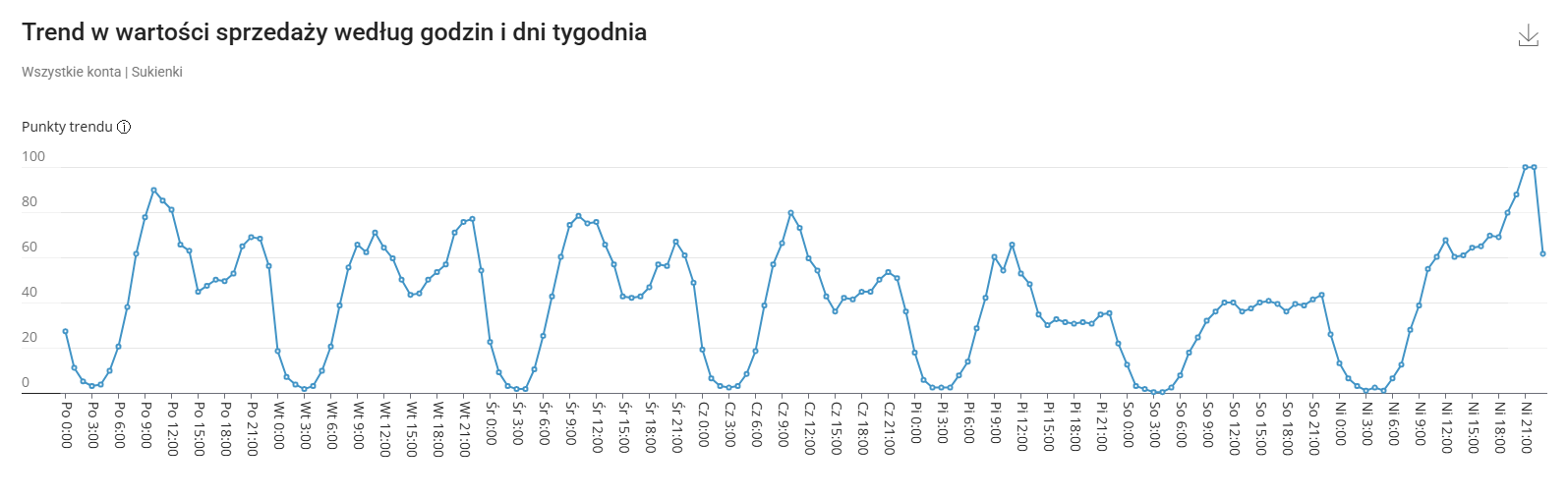
When planning tests and analysing their effects, also take into account that many categories on Allegro are characterised by seasonality and sudden sales spikes. An excellent example is the "Dresses" category
source: Allegro Analytics report, sales value trend by hours and days of the week
Clear sales windows are visible in both the morning and the evening part of the day. You can therefore test each of these time slots separately, which will let you determine which bids and budgets are most effective in a given period.
Unfortunately, the platform does not offer a function for automatically limiting ad delivery to selected hours. This means that by default it has to be done manually, by switching specific groups on and off at a given time, which can be extremely tedious.
At Traffic Trends we use our own, unique tools for this purpose, which let us fully automate the process and set a precise hourly schedule for your campaigns. This way we match ad delivery to the best sales windows for your assortment, optimising CPC bids and budgets to achieve even higher effectiveness.
How do I optimise budget and CPC bids in practice?
Optimisation activities depend strictly on specific sales results and on the return on investment relative to the goals you set for your ads. The level of sophistication of these processes also depends on the size of the account, the size of the budgets and the number of promoted offers.
We can, however, point out a few universal tips that will help you understand what steps are worth taking and how to manage Allegro Ads campaigns effectively.
Here are three practical optimisation rules that work regardless of product category:
First, raise CPC bids by PLN 0.05-0.10 in ad groups where the ROAS exceeds your set break-even threshold - it means these ads generate a profit and are worth showing more.
Second, lower CPC bids or pause showing offers that generate high costs but do not translate into more orders - keeping the current bids will not increase their effectiveness.
Third, move budget from offers with a low conversion rate to the assortment that generates the most transactions. Such a reallocation is far more effective than raising the total amount allocated to the whole campaign.
Also take into account that in periods of increased shopping interest - such as Black Friday, Christmas or Back-to-School - cost-per-click rates and overall advertising costs on Allegro rise because of the larger number of competing sellers. To keep ads running continuously during that time, plan a higher budget well in advance.
What is worth remembering about advertising on Allegro Ads?
Advertising on Allegro in 2026 is the standard way of competing for the attention of more than 21 million Polish buyers - the dynamic growth of advertising revenue on the platform clearly shows that sellers understand this. The keys to success in this ecosystem are a conscious choice of the format matched to the campaign goal, rigorous monitoring of ROAS and constant control of CPC bids, offer quality and correct reallocation of the budget between ad groups.
Starting on your own is entirely possible once you have set up an account and configured your first campaign.
With larger budgets and more complex structures, however, it is worth considering working with an experienced Allegro Ads agency, which will shorten the time needed to reach optimal sales results.
Allegro Ads is the advertising system built into the Allegro marketplace. It bills in two models: CPC (cost per click) and CPM (cost per thousand impressions). The system uses real-time bidding (RTB): every time a user types a phrase into the search box, an auction takes place between advertisers. The result depends on your CPC bid, the competitiveness of the category and the offer quality score.
Register a seller account, complete verification and activate the Allegro Ads panel. Then create a Sponsored Offers campaign, pick products with good reviews and organic demand, and set your CPC bid and the budget you have available. You will collect the first data for optimisation after 7-14 days of delivery. Still, watch the campaign daily to see how the budget is used throughout the day.
It depends strictly on the product categories you plan to promote. CPC rates usually range from about PLN 0.50-0.60 up to PLN 0.80 per click. The more offers you want to advertise, the higher the budget you need to invest. It is worth starting with bids slightly above the minimum for a given category and placement, with a daily budget of PLN 30-50, and then optimising based on the results.
The three main solutions are Sponsored Offers, Display Ads (graphic) and Video Ads (display solutions billed in the CPM model). It is also worth mentioning the advanced ecosystem for brands within the Brand Zone (Ads4Brands), intended for companies with larger budgets that combine many different advertising activities on the platform.
The most commonly analysed metrics are CTR, CPC, cost, ROAS and sales value. They let you draw sound conclusions and decide which elements of a campaign need improvement. An important part of the analysis is also constantly watching the percentage of the budget used during the day in each ad group. This tells you whether the funds are enough for all-day delivery or the budget runs out too early and limits your reach.
Yes - Sponsored Offers can be launched from just a few zlotys a day. The key is choosing products with good organic demand and high ratings, so that you maximise conversions with limited paid traffic. Small budgets require precise targeting and regular optimisation.
Check in turn: whether the CPC bid is right for your products, whether the daily budget is too low to cover all-day delivery, and whether the offer has a sufficient quality score (reviews, photos, a complete description). In the vast majority of cases the problem lies in one of these areas rather than in a system failure.
It is worth basing the process on three basic analytical rules:
Raise bids for profitable offers: Increase CPC bids by PLN 0.05-0.10 in ad groups where ROAS exceeds your break-even threshold. It means those ads make a profit and are worth showing more often.
Cut the cost of ineffective offers: Lower CPC bids or stop showing offers that generate high costs but do not translate into more orders. Keeping the current bids will not make them more effective.
Reallocate funds internally: Move budget from offers with a low conversion rate to the assortment that generates the most transactions. Structuring spend this way is far more effective than raising the total amount for the whole campaign.